- Gonarezhou National Park at a glance
- Getting there
- Entering from South Africa (via Mozambique)
- Crossing from South Africa to Mozambique via the Parfuri border
- Driving through Mozambique – Parfuri border to Sango border, via the Mapai “ferry”
- Crossing into Zimbabwe – Sango border
- Entering Gonarezhou National Park
- Entering from South Africa (via Beitbridge)
- Fuel – Where to fill up and what to expect
- Water – Where it’s available (and when to boil it)
- Roads & River Crossings – what “4×4 required” really means
- Campsites in Gonarezhou: a campsite-by-campsite cheat sheet
- Rossi Pools campsite
- Mabalauta Campsite
- Gorwe Pan Platform
- Chitove campsite
- Chivalilia campsite
- Chipinda Pools
- Connectivity: Cellphone signal, 2-way radios, WiFi and Starlink
- The Carry-in, Carry-Out Waste Policy
- What to Pack: What we needed and what we didn’t
- Fresh Produce
- Things that were super helpful
- Things that we didn’t need
- Keeping Kids Occupied Off-Grid
- Daily Rhythm: What a day in Gonarezhou actually looks like
- Is Gonarezhou worth the cost?
Gonarezhou National Park at a glance
Gonarezhou National Park is Zimbabwe’s second-largest national park and its least-visited, which is exactly what makes it worth the effort. It offers spectacular scenery and great wildlife viewing. But what distinguishes Gonarezhou from other parks is the truly authentic bush experience. Campsites are unfenced, roads are rough and few, visitors even fewer. The park’s scale and emptiness mean that encounters with wildlife carry a weight they have lost elsewhere. Camping in Gonarezhou isn’t for the faint of heart – but if you know what to expect, and have everything you need with you, it can be one of the most incredible camping experiences you will ever have!
Getting there
Entering from South Africa (via Mozambique)
The journey from Kruger National Park, briefly through Mozambique and across the Runde River is an adventure all of its own! Note we were driving South African registered vehicles, the process will be slightly longer with foreign registered vehicles. Also note that it was dry when we went through so we didn’t have to contend with much mud along the way.
Crossing from South Africa to Mozambique via the Parfuri border
Exiting Kruger at the Parfuri Gate, you immediately go through border procedures. This is a tiny outpost border, and as long as you have all your paperwork in order, it’s a quick and easy process to cross into Mozambique.
Exiting South Africa: handover your passports and you will be stamped out. Then hand over your car and trailer papers to the office, they enter the details into the South African system and then you are done. Nothing to pay, and all done at the one counter. Very professional and easy.
Entering Mozambique: drive through to the barrier and someone will come and open the boom gate. Park up on the left and then walk to the immigration office on the right hand side. Hand over your passports and get stamped in. Note if you are travelling on a non-SADC passport, you will need to obtain a visa pre-approval before getting to the border – even if you come from a country like the UK that is “visa-free”. Once clear of immigration, cross the road and head to the customs building. Hand in your vehicle papers, driver’s passport and your vehicle insurance for Mozambique (see more info below). They will give you a form to complete with all the vehicle information, this is your temporary import permit (TIP). Road tax is payable, it was ZAR50 per vehicle, payable in cash. There was a cursory check of the vehicles. The border officials were professional and helpful. Once all formalities completed at customs, drive to the next boom gate and show them your paperwork and passports, and then you are through. It took us about an hour in total for 2 vehicles with trailers.
About a kilometre down the road we were stopped by two police officers who suggested strongly that they needed some money to let us through. We paid around ZAR100 for each vehicle. No receipt was provided 🙂
Vehicle insurance for Mozambique – this needs to be arranged before you get to the border since it is such a small border. For South Africans, you can pick up this insurance at Outdoor Warehouse, just take all your car papers and your passport and it’s a quick and easy process. Cost depends on duration of stay.
Driving through Mozambique – Parfuri border to Sango border, via the Mapai “ferry”
As soon as you enter Mozambique from South Africa, the contrast between the two countries is obvious. The road east from Parfuri is potholed dirt, with frequent wash-aways. There are a couple of informal “tolls” to pay along the way (we usually paid around ZAR20 per vehicle). It’s slow going – count on around 15-20kmh, especially if you have a trailer.
We stayed the night at Dumela Safaris, about 9km past the border. It isn’t possible to get from Kruger through Mozambique and into Gonarezhou in one day, so you will need to stop for a night, and this is the place to do it.
From Dumela it is 74km to the “ferry” at Mapai (S22.802 E31.919). The 74km journey took us around 3.5 hours, so we would suggest leaving Dumela early (even if you do then miss out on their delicious bread rolls which are only available later in the morning).
The “ferry” is a simple pont which is pushed across the river by four or so very strong men with long poles. The crossing takes around 30 minutes per vehicle if no queue – most of this time is the loading and unloading on either side, the actual river crossing isn’t long.
Note that when the water is lower, there may be options for other smaller ferries, but it definitely wasn’t an option when we visited in July 2026.
Once you are off the ferry on the other side, it’s a sand track and then dirt roads for about 20km up to the town of Mapai itself where you will join the tar road west towards the Chiqualaquala / Sango border.
Crossing into Zimbabwe – Sango border
Exiting Mozambique: very straightforward, hand over passports and the TIP. Nothing to pay.
Entering Zimbabwe: very efficient and well organised. To make the process quicker, fill in the forms online before you arrive at the border via the Zimbabwe evisa website – a separate form is required for each traveller, including children. If you don’t fill in the forms you can do so on the tablets when you are at the border post. You will also need to purchase your Zimbabwe TIP at the border, again this can be done online pre-arrival which speeds up the border process, to do so go to the ZIMRA e-TIP Portal.
Entering Gonarezhou National Park
About 20 minutes after the border crossing, you will reach the Gonarezhou National Park entry gate. Here you will need to show your booking details and fill in a slip. We arrived quite late in the day and they offered to radio the office and let them know we had arrived and then we didn’t need to go to the main office before heading directly to our campsite – given the travel times in the park, it’s well worth asking at the gate if they can do this for you if you aren’t staying at the main camp.
Entering from South Africa (via Beitbridge)
The alternative route to Gonarezhou from South Africa is to go via Beitbridge, and then travel via Triangle and Chiredzi to enter the park at Chipinda Pools.
Fuel – Where to fill up and what to expect
Spoiler alert: you will use a lot of fuel driving through the park. The roads are often challenging and our average speed moving between campsites was usually around 15-20kmh. And if you are towing a trailer, that just adds to it…
If you have long range tanks, fill them before you get into the park. If not, maybe consider carrying a jerry can or two depending on how long you are in the park for. There is some limited fuel available in the park, at Makonde (near Rossi Pools) and at Chipinda Pools, however they have a USD50 purchase limit, and fuel must be purchased in cash.
Outside of the park, there is fuel available just before the Sango border post (coming from Moz into Zim), and at Chiredzi.
Water – Where it’s available (and when to boil it)
You need to be able to carry your own water, and lots of it. There is no water available at any of the Wilderness or Exclusive campsites. There is water available at Mabalauta (the office staff let us top our tanks there), at Chipinda Pools and Chinguli campsite.
A note about the water: we stayed for one night at Chipale Tented Camp for a touch of luxury amongst the camping. We were very excited to have running water in the kitchen and bathroom – we checked with the staff whether the water was drinkable, they said it was, and so we proceeded as such… only to find later that the water is sourced from the river and there is signage in some tents recommending that it be boiled before consumption.
Roads & River Crossings – what “4×4 required” really means
This really is high clearance 4×4 territory. And low range doesn’t go amiss either. Along with the rough roads, there are causeways and river crossings which can be very challenging depending on water levels. For several of the crossings it is recommended that you only attempt them if you are with another vehicle, especially if you are towing a trailer. And worth noting that the rivers are inhabited by a large number of crocodiles and hippos which adds to the excitement when you get stuck in a hole in the middle of a river crossing (ask us how we know…)
You can expect to travel about 15-20kmh on most roads outside of the road between Fishans and Chipinda Pools. However even on that “main” road, there are dips in the road (or as we like to call them, “Dongas of Doom”) which slow you down as soon as you hit cruising speed. There is also wildlife around of course, and the elephants can cause delays as can be much more aggressive/reactive towards passing cars than at other parks.
When we arrived in the park, only the Fishans and Chipinda Pools causeways were open. Later in our stay the Chitove causeway was opened, however it was quite an adventure to cross that one – if you would like to read all the details of how we were rescued by a road crew with an excavator, visit our Gonarezhou travel diary.
We ran through Gonarezhou with our tyres at around 1.8 – 1.9 bar.
Both vehicles in our group were towing offroad camping trailers. We saw several vehicles in the park towing much larger caravans or trailers. The reality is that if you are going to really explore Gonarezhou, you will find yourself on roads and river crossings that really aren’t suitable for large trailers or caravans. We would recommend keeping your setup as compact and off-road friendly as possible.
A final note about roads and driving in Gonarezhou: we strongly recommend that you travel through Gonarezhou with more than one vehicle. With so little traffic it could be hours before another vehicle drives past you, and there is plenty that can go wrong along the way (again, ask us how we know…)


Campsites in Gonarezhou: a campsite-by-campsite cheat sheet
Campsites in Gonarezhou are split into a couple of different categories:
| Type of campsite | Campsite names | Facilities |
| Developed campsites | Chipinda Pools, Chinguli, Mabalauta | Multiple campsites each with a thatched rondavel and braai area/fire pit, shared ablutions |
| Exclusive campsites | Directors, Hlaro, Chilojo, Chitove, Machinawa, Chamuluvati | Simple bush camping site with a firepit and long drop toilet. No running water. |
| Wilderness campsites | Chivilila, Runde Gorge, Fishans, Bopomela, Lisoda, Pokwe, Gayiseni, Gorwe, Nyavasikana, Malilangani, Rossi Pools | Simple bush camping site with a firepit and long drop toilet. No running water. |
| Transit campsites | Mutamagwenzi, Tondo, Guluweni | Simple bush camping site with a firepit and long drop toilet. No running water. 2 night max stay. |
| Platform | Bhenji Weir, Malugwe, Gorwe Pan | 3×6 metre wooden platform with firepit / braai area and long-drop loo. |
We were able to stay at quite a few campsites during our time in Gonarezhou – here’s an overview of the ones we stayed at or visited – listed from south to north
Rossi Pools campsite
A wilderness campsite with a long drop loo and a thatched rondavel overlooking the river valley below. Funky moveable braai, and the best long drop in the park.


Mabalauta Campsite
A developed campsite with ablution blocks. Main office for the southern part of the park is here too (and has WiFi if you need it). We didn’t stay here but campsites 1 to 3 look the best – overlooking the river and near the ablutions.


Gorwe Pan Platform
What a memorable night! Sleeping out under the stars on a wooden platform high above the ground, overlooking a pan where elephants came in to drink after dark. Second best long drop in the park.


Chitove campsite
A strong contender for our favourite campsite, we had 4 nights here. Nice flat campsite overlooking the river, fantastic for bird watching and observing the hippos and crocs in the river. Long drop loo was fine. Nice big shady tree on the river’s edge, even in July we were grateful for shade in the middle of the day.


Chivalilia campsite
A beautiful campsite on a rocky plateau overlooking the river and its banks, and with beautiful views into the valley. We had some of our best wildlife experiences here with a herd of elephant wandering through, kudu climbing the hills, and a troop of baboons passing peacefully by. It was also where we were most aware of the potential dangers of the animals around us, with a wounded hippo grazing at the bottom of the rocks and reports of lions being seen at the campsite in the days before we arrived there. The campsite has a lovely rondavel and an the long drop toilet was ok. The road down to the campsite is rough and slow going – around 10 minutes to do 1.5km. There is some cellphone reception on the road down to the campsite. Bit of a tricky campsite if you have a tent that needs to be pegged down – fortunately lots of large rocks to tie guy ropes to… just be careful of the scorpions!


Chipinda Pools
The main developed campsite, located close to the entrance gate and main office and workshop areas. The campsite itself is lovely, we were in Site 9 which was a much sought-after campsite, campsite 8 is also lovely, and campsite 7 looked great but apparently had issues with hippos using it as a thoroughfare at night. Each campsite has a rondavel and a tap with running (borehole) water (oh, the luxury!), and a braai / fire pit. The shared ablutions are simple but clean. The campsite is fenced to prevent elephants from entering, but otherwise unfenced and we had some issues with a hyaena coming into camp and sniffing around the tents at night. Some cellphone signal at times, but only intermittent.


Connectivity: Cellphone signal, 2-way radios, WiFi and Starlink
Gonarezhou is the type of place that you go to get away from it all. However, not everyone can just disconnect from real life for the whole time they are in the park, so here’s where you can find WiFi and cellphone signal, and other options for staying connected.
- Wifi: only available at Chipinda Pools reception and Mabalauta reception.
- Cellphone signal: patchy signal at Chitove, Chipinda Pools site 9 and the road into Chivalilia. Also some patchy signal on the road between Fishans and Chipinda Pools. eSims were problematic, the best connection was through roaming with Vodacom South Africa, R99 for 1GB. Definitely not enough signal strength to do much more than WhatsApps.
- Starlink: we met a few travellers who were running Starlink and who were finding they had good coverage wherever they needed it.
- 2-way radios: as we were two vehicles travelling together, 2-way radios made it easy to stay in touch while we were on the road. Highly recommend.
The Carry-in, Carry-Out Waste Policy
Gonarezhou operates a strict carry-in, carry-out waste policy. They charge USD 30 for any refuse removal, including recyclables (although this does seem to be waived if staying in accommodation rather than camping).
Worth bearing in mind when you are packing – bringing cans that can be crushed rather than bottles or jars which take up a lot of space when empty. And if you are a wine drinker, don’t knock a bit of box wine, much easier to pack and takes up no space once empty.
What to Pack: What we needed and what we didn’t
We were in the park for 12 nights, and we carried enough food between the two vehicles to cater for the entire time we were in the park, plus the nights before we entered the park (in Kruger and Mozambique). Park management recommends you carry at least two days of spare food and water per vehicle in case you get stranded.
Fresh Produce
What lasted: cabbage, carrots, peppers, naartjies, lemons, apples, cherry tomatoes, potatoes, onions, frozen/packaged veg (especially packaged veg from Woolworths)
What didn’t last: broccoli, cauliflower, avocados, large tomatoes
Things that were super helpful
On top of the usual camping kit, here are some things that we really enjoyed having with us:
- Sasol birding app (we spent a lot of time watching birds, this was the perfect companion)
- Insulated cups (great for hot and cold drinks)
- Toilet paper (pack what you think you need and then add a few more rolls)
- Battery shower and a shower curtain (it was a long time between ablution blocks)
- Tracks4Africa app or Maps.me app (both work offline once maps are downloaded)
- Solar power (there’s nothing more satisfying than generating your own power!)
- Lots of fridge capacity (plus the ability to have a fridge and a freezer)
- String lights and rechargeable lanterns
- Hammocks (not that the adults got to spend much time in them!)
Things that we didn’t need
- Too many clothes (you don’t need as many changes of clothes as you think)
- She-wee
Keeping Kids Occupied Off-Grid
We had 4 kids with us, ranging from 9 to 15 years old. All of the kids have spent time in the bush before, but even so, we had to have a couple of serious conversations with them about staying safe in an unfenced reserve like Gonarezhou.
Keeping them occupied off-grid was actually easier than we expected despite not being able to run around much. Without the possibility of screen time, they found ways to entertain themselves: digging, beach bats, whittling, watercolours, bead-making, skipping rope, hopscotch, boule, DIY gym gear from rocks and branches. They even put their Grade 6 science experiment into real use creating a water filter from a plastic bottle, sand and rocks.
Daily Rhythm: What a day in Gonarezhou actually looks like
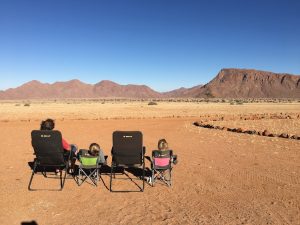
For us, Gonarezhou isn’t a game driving park. Our best wildlife viewing came when we were sitting in the campsite, with the luxury of time to watch the interactions between animals, and observing them truly in their natural habitat seemingly unaware of our presence.
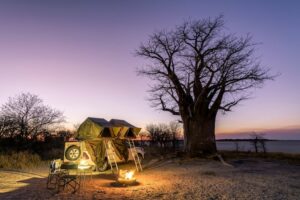
The reality of an unfenced campsite, especially when travelling with kids, is that we felt more comfortable in our tents when it was dark outside. We were up at dawn, often watching the sunrise with a tea or coffee in hand, listening to the sounds of the bush waking up. If we were staying in camp for the day, there was of course time spent on meals and occasional chores like washing, but the majority of the time for the adults was spent watching the wildlife and simply enjoying being totally off-line in the bush. Dinner at dusk, and bed once it was dark.
On travel days, it takes time to pack up camp, and then the state of the roads meant that it was often a good few hours to move between campsites.
Is Gonarezhou worth the cost?
Gonarezhou is an expensive destination. Accommodation and park fees are expensive relative to other parks in southern Africa. The roads in the park are challenging and tough on the vehicles (and fuel economy). And for us travelling from the Cape, it was also an expensive exercise to get to Gonarezhou in the first place (it was a round trip of over 6,000km). But was it worth it? Absolutely. This trip was one of the best trips we have ever done, anywhere in the world.